

Clean Architecture in Android promotes the separation of responsibilities into layers, such as :data, :domain, and
:presentation, to achieve modular and maintainable code. Each layer focuses on specific concerns, improving code
readability and maintainability.
📘 Introduction
I have worked on several projects and observed different implementations of this pattern. Here I explain how to divide these layers for better context.
Two Approaches for Dependency Implementation 🔧
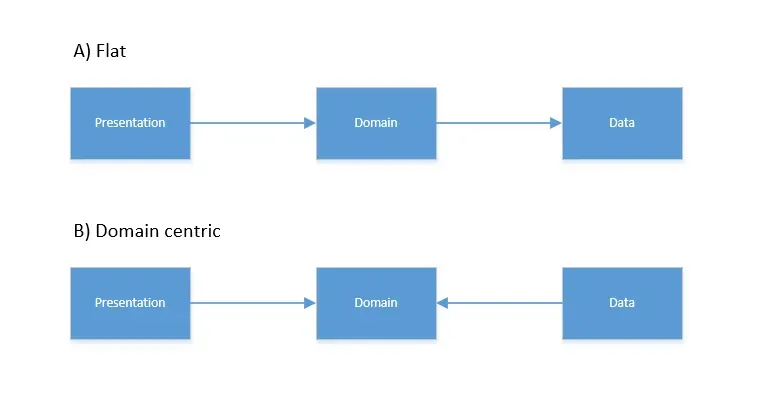
🏢 Flat Style
The “Flat Style” allows :presentation to depend on :domain, exposing all public classes from :data to
:domain. This can make it difficult to test business logic and goes against the Dependency Inversion Principle.
🧩 Domain-Centric Approach
This approach ensures that :domain does not directly know :data, using dependency injections through interfaces or
abstract classes.
Benefits:
- Decoupling: Each layer only knows the abstractions of the lower layer.
- Testability: Facilitates independent testing.
- Focus on Domain Layer: Business logic remains agnostic to specific data sources.
- Flexibility in Data Sources: Allows changes without affecting
:domain.
🛠️ Implementation in Koin
Koin is a lightweight framework for dependency injection. It is initialized with startKoin, using Koin modules to
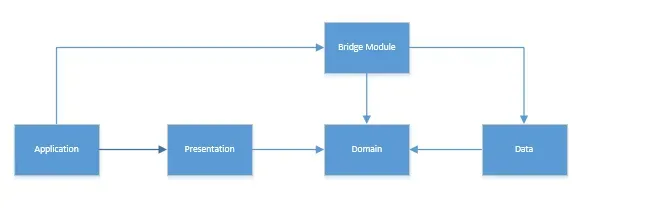
instantiate singletons or factories. A Bridge Module allows Koin to reference classes from the Data module
without direct visibility.
🌉 Bridge Module Solution
The :app module does not directly access :domain or :data, but uses Koin modules in :bridge, keeping the
:domain layer isolated and respecting the principles of Clean Architecture.
class MyApplication : Application() {
    override fun onCreate() {
        super.onCreate()
        startKoin {
            androidContext(this@MyApplication)
            KoinLogger()
            modules(viewModelModule, localModule, remoteModule, domainModule)
        }
    }
}
Gradle Configuration
Bridge Module in build.gradle:
dependencies {
    implementation "io.insert-koin:koin-androidx-compose:${libVersions.koin_version}"
    implementation(project(":domain"))
    implementation(project(":data:repository"))
    implementation(project(":data:remote"))
}
For more information, check out this article.